
[av_textblock size=” font_color=” color=” av-medium-font-size=” av-small-font-size=” av-mini-font-size=” av_uid=’av-k7nqhzm4′ admin_preview_bg=”]
How long does it take to go from Band 6 to Band 7?
“Your feedback was more elaborate and was custom-tailored to each student, which indicates how much you actually care about your students.”
Dr. Akeil A.F.
No, you can’t go from Band 6 to Band 7 after only a few writing assignments IF you have significant vocabulary and grammar issues. Anyone who tells you that you can jump a Band quickly is lying.
Many students join my course after trying lots of other self-study courses, writing correction services, and learning centre IELTS classes. They find after completing these other courses that their Band scores don’t change much, and sometimes their scores don’t change at all. The reason is that writing improvement REQUIRES a lot of writing WITH TEACHER FEEDBACK on every writing assignment, and it requires that you revise your work and have it rechecked by the teacher. Just having your writing corrected doesn’t help YOU learn because you are not DOING anything. Learning to write involves writing, not reading about writing. If you are not revising your work and getting it re-checked, you have NO IDEA if you have understood the feedback. However, providing this level of personalized feedback is time consuming and expensive, and that’s why nobody wants to provide it.
Toronto IELTS Prep is completely different. This learning system is based on giving you detailed feedback, requiring that you revise your work, and then re-checking it. This is NOT an essay correction service. This is actual teaching. I will coach you step-by-step how to become a good writer.
Nobody wants to tell you the truth about how long it can take to go up a full Band. Everyone wants you to believe that it’s easy, that tips and tricks will help you make that jump quickly. This is absolutely not true – believing this will delay your progress.
Research by Cambridge and CCLB (Centre for Canadian Language Benchmarks) shows that it takes the average student 200 to 250 hours to go up one Band score. This is the only program that will give you enough training and practice opportunities to make this huge jump in your English level. The sooner you accept this fact, the sooner you will start to make progress.
The fact is that Band 7 means you are a competent writer. Becoming a competent writer is your REAL goal. Band 7 is advanced level English. It means your writing causes ZERO confusion for the reader. Doctors in Canada need Band 7 in every category for this reason: if what they say or write causes confusion, it can KILL you!
Getting your writing to this level is one of the most valuable skills you can ever learn. It will improve the quality of your entire life. This is the best investment you can make in your future because you will come out of this program a competent writer.
Call me today and I’ll make sure that you get started today. You can reach me at 416 822 2637, at jan@testing.torontoieltsprep.com, or on WhatsApp at Jan Waginski.
[/av_textblock]
[av_hr class=’default’ height=’50’ shadow=’no-shadow’ position=’center’ custom_border=’av-border-thin’ custom_width=’50px’ custom_border_color=” custom_margin_top=’30px’ custom_margin_bottom=’30px’ icon_select=’yes’ custom_icon_color=” icon=’ue808′ av-desktop-hide=” av-medium-hide=” av-small-hide=” av-mini-hide=” av_uid=’av-3oj6kl’]
[av_textblock size=” av-medium-font-size=” av-small-font-size=” av-mini-font-size=” font_color=” color=” id=” custom_class=” av_uid=’av-k7nqhzm4′ admin_preview_bg=”]
Q. Why have I been stuck on Band 6.5 in writing for so long? All my other scores are much higher!
The main reason is that writing is the hardest skill to develop. In speaking, sentence structure and vocabulary matter much less: the listener can’t tell where one sentence ends and another begins. In terms of vocabulary, our spoken vocabulary is MUCH smaller than our written vocabulary.
As well, Band 7 is really hard because Band 7 is advanced level English. Going from Band 6.5 to Band 7 is a big jump. Band 6 is intermediate level English. Band 7 is advanced level English.
- Band 7 means your writing causes ZERO confusion for the reader.
- Band 7 means your writing feels effortless.
- Band 7 means your writing has a wide variety of complex sentences, most of which are FLAWLESS.
- Band 7 means what you say causes ZERO confusion for the listener.
- Band 7 means ideas come to you effortlessly when you’re speaking, and that your speech flows smoothly unlike the choppy speech of beginners.
It’s extremely difficult to get to Band 7 on your own because a wide variety of problems will keep you stuck at Band 6. Any content development issue, vocabulary problem, or grammar mistakes that cause ANY confusion for the reader will automatically prevent you from reaching Band 7.
An experienced teacher can help you shortcut the learning process by telling you EXACTLY what’s wrong with your writing and how you can improve. An experienced teacher will show you what you need to focus on in your improvement plan so that you don’t waste time on things that won’t make much difference to your score.
[/av_textblock]
[av_hr class=’default’ height=’50’ shadow=’no-shadow’ position=’center’ custom_border=’av-border-thin’ custom_width=’50px’ custom_border_color=” custom_margin_top=’30px’ custom_margin_bottom=’30px’ icon_select=’yes’ custom_icon_color=” icon=’ue808′ av-desktop-hide=” av-medium-hide=” av-small-hide=” av-mini-hide=” av_uid=’av-24r2wl’]
[av_textblock size=” font_color=” color=” av-medium-font-size=” av-small-font-size=” av-mini-font-size=” av_uid=’av-k7nrryvk’ admin_preview_bg=”]
This level of improvement does not happen without a lot of work!
Your writing topic on the exam comes from a pool of THOUSANDS of topics. A couple lessons will not make much difference unless you are already getting Band 7+ on every skill except writing. ONLY if you’re getting 7+ on Reading, Listening, and Speaking can you get to Band 7 on writing quickly.
[/av_textblock]
[av_layout_row border=” min_height_percent=” min_height=’0′ color=’main_color’ mobile=’av-flex-cells’ id=” av_element_hidden_in_editor=’0′ mobile_breaking=” av-desktop-hide=” av-medium-hide=” av-small-hide=” av-mini-hide=” av_uid=’av-7zzgmd’]
[av_cell_one_third av_uid=’av-6jt15x’]
[av_textblock size=” font_color=” color=” av-medium-font-size=” av-small-font-size=” av-mini-font-size=” av_uid=’av-k7nrug0j’ admin_preview_bg=”]
Band 6
[/av_textblock]
[av_image src=’https://testing.torontoieltsprep.com/wp-content/uploads/2020/03/Band-6.jpg’ attachment=’4249′ attachment_size=’full’ align=’center’ styling=” hover=” link=” target=” caption=” font_size=” appearance=” overlay_opacity=’0.4′ overlay_color=’#000000′ overlay_text_color=’#ffffff’ copyright=” animation=’no-animation’ av_uid=’av-k7nru09x’ admin_preview_bg=”][/av_image]
[/av_cell_one_third][av_cell_one_third av_uid=’av-g6nj9′]
[av_textblock size=” font_color=” color=” av-medium-font-size=” av-small-font-size=” av-mini-font-size=” av_uid=’av-k7nrug0j’ admin_preview_bg=”]
Band 6.5
[/av_textblock]
[av_image src=’https://testing.torontoieltsprep.com/wp-content/uploads/2020/03/Band-6.5.jpg’ attachment=’4250′ attachment_size=’full’ align=’center’ styling=” hover=” link=” target=” caption=” font_size=” appearance=” overlay_opacity=’0.4′ overlay_color=’#000000′ overlay_text_color=’#ffffff’ copyright=” animation=’no-animation’ av_uid=’av-k7nru09x’ admin_preview_bg=”][/av_image]
[/av_cell_one_third][av_cell_one_third av_uid=’av-2nug9x’]
[av_textblock size=” font_color=” color=” av-medium-font-size=” av-small-font-size=” av-mini-font-size=” av_uid=’av-k7nrug0j’ admin_preview_bg=”]
Band 7
[/av_textblock]
[av_image src=’https://testing.torontoieltsprep.com/wp-content/uploads/2020/03/Band-7.jpg’ attachment=’4251′ attachment_size=’full’ align=’center’ styling=” hover=” link=” target=” caption=” font_size=” appearance=” overlay_opacity=’0.4′ overlay_color=’#000000′ overlay_text_color=’#ffffff’ copyright=” animation=’no-animation’ av_uid=’av-k7nru09x’ admin_preview_bg=”][/av_image]
[/av_cell_one_third]
[/av_layout_row]
[av_hr class=’default’ height=’50’ shadow=’no-shadow’ position=’center’ custom_border=’av-border-thin’ custom_width=’50px’ custom_border_color=” custom_margin_top=’30px’ custom_margin_bottom=’30px’ icon_select=’yes’ custom_icon_color=” icon=’ue808′ av-desktop-hide=” av-medium-hide=” av-small-hide=” av-mini-hide=” av_uid=’av-24r2wl’]
[av_textblock size=” font_color=” color=” av-medium-font-size=” av-small-font-size=” av-mini-font-size=” av_uid=’av-k7nqhzm4′ admin_preview_bg=”]
Q. Some people in other programs say they went up a Band really quickly, after only a few lessons. Is it true that you can go up one Band quickly?
Maybe. It depends on whether you have an IELTS problem or an English problem.
Some people ONLY have an IELTS problem. I have helped people go up a full band in only ONE class. All of them had the following characteristics in common:
- They had a very high level of oral fluency.
- They made only a few grammar mistakes when speaking.
- They had a very large vocabulary.
- They had only a few grammar mistakes in their writing.
- They had only a few vocabulary mistakes in their writing.
What was their problem? They had many problems either with the organization of their writing or their content choices. Essentially, they were not answering the question properly but their grammar and vocabulary were very good or excellent. Even a native English speaker can receive a low score on writing if they answer the question in the wrong way. For example, if the question only requires a comparison of two perspectives but you write about why one perspective is better than the other, you’ll receive a low score on Task Achievement.
This is an easy problem to fix! IELTS marks your writing based on content (Task Achievement), organization (Coherence and Cohesion), and delivery (Lexical Range and Grammar). The content and organization requirements are easy to understand. The key to getting high marks on Task Achievement is to answer every part of the question precisely and with sufficient detail. The key to getting high marks on Coherence and Cohesion is to organize your writing in a way that is easy to understand. The reason why these two requirements are easy to understand is because THEY ARE THE SAME IN EVERY LANGUAGE! Answer the question given by your teacher (not a different question and not just part of the question) and organize your answer in a way that’s easy to understand. That’s it! It doesn’t matter what language you’re writing in: there is ONE WAY to do this correctly and it has not changed since Aristotle wrote Rhetoric 2400 years ago.
However, this is not the typical IELTS student! The students you see in promotional videos who say they went up a Band quickly already had a high level of fluency. That does not mean YOU will go up a Band quickly! Don’t get tricked by testimonials that do not represent the typical student. These students had trouble with the first two categories on the rubric below: Task Achievement and Coherence and Cohesion. They DIDN’T have much trouble with Lexical Resource or Grammatical Range and Accuracy. These take time to improve.
[/av_textblock]
[av_image src=’https://testing.torontoieltsprep.com/wp-content/uploads/2018/07/IELTS_task_2_Writing_band_descriptors-1.png’ attachment=’1712′ attachment_size=’full’ align=’center’ styling=” hover=” link=” target=” caption=” font_size=” appearance=” overlay_opacity=’0.4′ overlay_color=’#000000′ overlay_text_color=’#ffffff’ copyright=” animation=’no-animation’ av_uid=’av-k7nqxeqy’ admin_preview_bg=”][/av_image]
[av_hr class=’default’ height=’50’ shadow=’no-shadow’ position=’center’ custom_border=’av-border-thin’ custom_width=’50px’ custom_border_color=” custom_margin_top=’30px’ custom_margin_bottom=’30px’ icon_select=’yes’ custom_icon_color=” icon=’ue808′ av-desktop-hide=” av-medium-hide=” av-small-hide=” av-mini-hide=” av_uid=’av-24r2wl’]
[av_textblock size=” font_color=” color=” av-medium-font-size=” av-small-font-size=” av-mini-font-size=” av_uid=’av-k7nqhzm4′ admin_preview_bg=”]
Most people don’t have an IELTS problem. They have an English problem.
Building your vocabulary and improving your grammar take much longer. If your only problems are with content and organization, I can help you very quickly. If your vocabulary is inadequate (inadequate = not good enough) and you make many grammar mistakes, it will take much longer to reach Band 7, which is a high level of writing. No tips and tricks will help you.
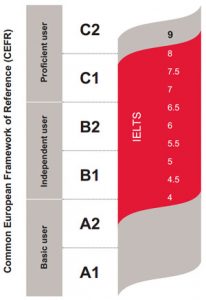 According to Cambridge,
“It takes approximately 200 guided learning hours for a language learner to progress from one level of the Common European Framework of Reference (CEFR) to the next”
https://support.cambridgeenglish.org/hc/en-gb/articles/202838506-Guided-learning-hours
That means if you’re at a Band 6 and you need Band 7, you’re looking at about 200-250 hours of GUIDED instruction. This is equivalent to two full high school courses (in Ontario, high school courses are 110 hours of class time, plus assignments and homework). Basically, you need to take the equivalent of grade 11 English and grade 12 English, but with a focus solely on IELTS tasks. That 200-250 hours DOES NOT INCLUDE STUDYING TIME.
If you come to my Saturday class, which runs from 9-1, that’s one year.
Teacher feedback is the most important part of learning to write. It is the fastest way to learn to write. That’s why it is a central feature of this training system. When you join the program, you can take up to one year to complete your writing assignments. After each writing assignment, you’ll receive feedback from me. You will then revise your writing based on my feedback and submit your work again. I will re-check it, explain in detail how you should improve it, and provide follow-up exercises. Your writing will improve after each assignment!
The IELTS speaking interview is about 13 minutes long – you can’t fake it. Examiners are assessing you according to these criteria:
- Fluency and coherence: Can you express yourself fluently without hesitation? Can you fully develop a topic?
- Lexical resource (vocabulary): Can you use a wide range of vocabulary precisely, including less common words, phrases, and idioms? Do you have the vocabulary to discuss less familiar topics at length?
- Grammatical range and accuracy: In a 13 minute conversation, are 1/3 to 1/2 of your sentences error-free? Are you comfortable using complex structures? Are you fully comfortable with all the verb tenses, passive and active voice, and unreal conditional?
- Pronunciation: Is your speaking stress-timed or syllable-timed? Does your accent have only a minimal effect on intelligibility, i.e. are you easily understood by native speakers?
Test-related anxiety or lack of familiarity with the test format will lower your score. You can deal with this by taking practice tests and becoming familiar with common speaking prompts.
Vocabulary and grammar are much more easily improved through writing practice than through speaking practice. As the number of errors decreases in your writing, the number of errors decreases in your speaking.
Moreover, the correlation between reading comprehension and speaking is about 90% – if you don’t have anything to say, it’s because you’re not reading enough (reading nonfiction is the best way to improve your vocabulary).
Pronunciation improvement requires coaching and/or modelling (listening to examples, recording yourself, comparing your recording to the examples, and making improvements).
The bottom line is this: yes, you can go up one band score in a month with intensive one-on-one or small group coaching. If you don’t have this luxury, it will take longer.
[/av_textblock]